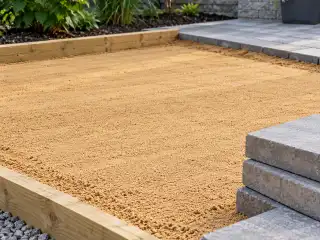
Sand calculator
Multiply the measured area by the sand depth to estimate volume, then divide cubic feet by 27 for cubic yards. This tool shows tons only when you enter the supplier’s tons-per-yard figure. Sand type, moisture and the loose-versus-placed quantity basis must match the quote.
- Exact volume
- Area
- Estimated material cost
How do I measure the sand I need?
- Identify the sand product and intended use before measuring. Ask the supplier whether its quote describes loose bulk volume, weight or packaged material. Different grading and intended uses should stay on separate purchase lines.
- Measure the actual footprint in feet. Split irregular areas into nonoverlapping sections or draw the outline. Exclude areas that will not receive sand and keep sections with different planned depths separate.
- Enter depth in inches and choose an explicit allowance. If your measurement is for a finished compacted layer while the supplier sells loose material, obtain the appropriate conversion basis instead of inventing a multiplier.
- Review net volume, allowance-adjusted volume and rounded order. Enter supplier weight or pricing information only when it applies to the selected sand and condition. Confirm delivery access, minimum loads and package yield before buying.
How is the quantity calculated?
Cubic yards = area (sq ft) × depth (in) ÷ 12 × (1 + waste % ÷ 100) ÷ 27
- Area is the footprint receiving sand. Depth describes the layer you measured; the tool does not choose an installation depth.
- The volume result includes your selected allowance. The suggested order rounds up to a quarter cubic yard as a tool convention; confirm the supplier’s actual selling increment.
- Short tons = calculated cubic yards × entered short tons per cubic yard. There is no default density, hidden compaction factor or automatic bag-yield assumption.
Example: a 12 × 15 ft area with a 2 in sand layer
Illustrative footprint, selected depth and a chosen 5% allowance. No density or price is assumed; these dimensions do not specify a paving or landscaping assembly.
- Area: 12 × 15 = 180 sq ft; entered depth: 2 in.
- Selected allowance: 5%; no supplier weight conversion supplied.
- Net volume is 30 cu ft.
- Including the allowance gives 31.5 cu ft.
- Divide by 27 for 1.17 cu yd before order rounding.
- The tool’s quarter-yard round-up gives 1.25 cu yd; tons remain unavailable without the supplier’s conversion.
1.25 cu yd as a rounded volume comparison. Confirm the actual selling increment and loose/placed basis with the supplier.
How does sand depth change the volume?
| Entered depth | Net cu yd | Adjusted cu yd | Rounded order, cu yd |
|---|---|---|---|
| 0.5 in | 0.28 | 0.29 | 0.5 |
| 1 in | 0.56 | 0.58 | 0.75 |
| 1.5 in | 0.83 | 0.88 | 1 |
| 2 in | 1.11 | 1.17 | 1.25 |
| 3 in | 1.67 | 1.75 | 1.75 |
| 4 in | 2.22 | 2.33 | 2.5 |
How many cubic yards of sand do I need?
Measure the footprint receiving sand and multiply its square footage by the depth in feet. When depth is entered in inches, divide by 12 first. Divide the resulting cubic feet by 27 to express the volume in cubic yards, then review the allowance you have chosen for the job.
The rounded order can be larger than the calculated volume because the tool rounds up to quarter yards. That increment is a calculation convention, not a promise that every yard sells or delivers that amount. Confirm the supplier’s minimum and increment before using the result as a purchase order.
How do I convert cubic yards of sand to tons?
Ask the supplier for the weight conversion for the selected material and condition. Enter short tons per cubic yard, and the calculator multiplies that value by the allowance-adjusted volume. Without that input, it leaves tons unavailable rather than supplying a universal density.
Weight and volume are different quantities. Moisture, grading and handling conditions can change the conversion relevant to a delivery. Keep the supplier’s basis with the estimate, and confirm whether the quote uses U.S. short tons or another weight unit. A generic internet density does not establish the delivered weight of your selected sand.
Does the result include compaction or loose-to-placed conversion?
No automatic conversion is applied. The volume calculation describes the footprint and depth you enter, plus the explicit allowance. If that depth represents a finished placed layer but the quote is for loose material, an additional documented quantity basis may be needed.
Obtain that basis from the supplier or project specification. A waste percentage and a compaction factor describe different adjustments; using one to hide the other makes the estimate hard to check. Do not apply a second factor when the supplier’s quantity already includes the conversion, and retain the stated assumptions with the saved line.
Can I use the same sand for every project?
The calculator estimates quantity; it does not select a sand specification. The linked QUIKRETE All-Purpose Sand page identifies that particular coarse graded product and its stated uses. That description does not make all sand products interchangeable for bedding, masonry, joints, play areas or other applications.
Start with the intended assembly and its product requirements, then estimate that material. Keep specialty joint sand and other packaged products separate from a bulk layer calculation when their purchasing unit or yield differs. A matching volume alone cannot show that a product has the grading or application characteristics the project requires.
How many bags of sand should I buy?
Use the labeled volume yield of the exact bag product and divide the required volume by that yield, rounding up to whole bags. A dry bag weight alone does not establish a universal finished volume for every sand. This bulk calculator does not assume that every bag covers the same area or depth.
If the manufacturer provides coverage for a particular application, check its depth and installation basis before converting it. Do not substitute a joint-filling coverage chart for a continuous bedding layer. Retain the product name, package size and yield with a separate packaged-material estimate so the order remains traceable.
Why can a price per yard differ from a price per ton?
The quotes use different quantity units and may also describe different delivery terms. The price field on this page multiplies the rounded yard order by your entered price per cubic yard. If the supplier quotes by weight, use its product-specific conversion to check the estimated tons and ask for the corresponding quoted total.
Compare matching material, moisture or quantity basis, allowance, minimums and delivery scope before deciding which quote costs less. Keep tax, hauling and unentered fees outside the material subtotal. The estimated tons do not automatically specify a truckload or a supplier’s weight-order increment; confirm both with the yard rather than comparing the numeric unit prices alone.
How do I estimate the material cost?
Enter a current supplier quote per cubic yard. If the quote uses short tons, enter the supplier’s weight conversion to check that quantity and confirm its quoted total separately. Keep the selected basis with the saved estimate, then confirm order minimums, hauling and other charges.
Content updated . How we calculate. Source checks are listed below each reference.