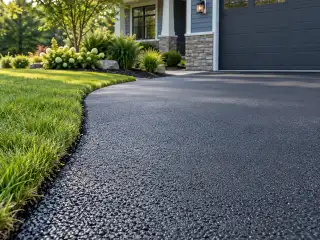
Asphalt calculator
At an estimating density of 145 lb/ft³, a 3 in compacted asphalt layer uses 36.25 lb per square foot before extra material. Enter the area, finished thickness and your plant’s density to estimate short tons and cost.
- Area
- Thickness
- Estimated material cost
How do I measure an asphalt driveway?
- Measure each paved section in feet. Multiply length by width for rectangles; split a widening driveway into separate sections or use the drawing tool for an irregular outline. Leave unpaved beds and islands outside the measured area.
- Enter the planned compacted thickness in inches. If the job has several lifts with different mixtures or depths, calculate each lift separately and label its saved estimate so the plant knows which material it describes.
- Check the density with the plant or project specification. The general Iowa DOT estimating value is a starting reference, not proof that every surface, base or specialty asphalt mix has the same density.
- Choose an explicit allowance for the measured job. Review the volume and rounded order, then confirm delivery, truck access, minimum charges and scheduling with the supplier before placing an order.
How is the quantity calculated?
Short tons = area (sq ft) × thickness (in) ÷ 12 × density (lb/ft³) ÷ 2,000 × (1 + waste % ÷ 100)
- Area is the pavement footprint, not its perimeter. Add separate areas without counting overlaps twice.
- Thickness is the finished compacted layer thickness supplied by the project. This calculator does not choose a pavement design.
- One U.S. short ton is 2,000 lb. The order result rounds up to a tenth of a short ton; confirm the plant’s minimum order and increment separately.
Example: a 12 × 50 ft driveway at 3 in
Illustrative dimensions, 145 lb/ft³ estimating density and a selected 5% allowance. This is a material takeoff, not a recommended pavement section.
- Area: 12 × 50 = 600 sq ft.
- Finished thickness: 3 in; selected allowance: 5%; density: 145 lb/ft³.
- Before the allowance, volume is 150 cu ft.
- Including the allowance gives 157.5 cu ft, or 5.83 cu yd.
- That adjusted volume weighs 11.42 short tons before order rounding.
- Rounding up to the calculator’s tenth-ton increment gives 11.5 short tons.
11.5 short tons for this selected scope; supplier charges and minimum loads are separate.
How does asphalt thickness change the tonnage?
| Area | Compacted depth | Net cu yd | Order, short tons |
|---|---|---|---|
| 600 sq ft | 1 in | 1.85 | 3.9 |
| 600 sq ft | 2 in | 3.7 | 7.7 |
| 600 sq ft | 3 in | 5.56 | 11.5 |
| 600 sq ft | 4 in | 7.41 | 15.3 |
| 600 sq ft | 5 in | 9.26 | 19.1 |
| 600 sq ft | 6 in | 11.11 | 22.9 |
How many tons of asphalt do I need?
Calculate the compacted volume first, then multiply by the selected mix density and convert pounds to short tons. A square-foot measurement alone cannot determine tonnage: the same footprint takes more material when the layer is thicker. Make sure your length and width describe the pavement you actually intend to place.
Read the selected allowance and the rounded result as separate steps. The raw material weight is a calculation; the final order is rounded for the tool’s display increment. A plant may quote a different increment or impose a minimum load. Confirm those terms rather than treating the displayed tenth of a ton as a supplier commitment.
What density should I use for hot mix asphalt?
The default comes from the Iowa DOT general HMA estimating value of 145 lb/ft³. The same current table lists different values for named layers and districts, and the older FHWA estimating table gives 145.2 lb/ft³. These references support an estimate; they do not establish the density of your particular plant mix.
If your supplier or project provides a density, enter it and record the mixture it belongs to. Do not substitute the density of loose aggregate, reclaimed asphalt, binder or sealcoat. Their quantities describe different materials and cannot be converted into the correct paving order just by keeping the same area.
Should I enter loose or compacted asphalt thickness?
Use the finished compacted thickness for this volume-and-density method. A contractor may discuss a thicker loose lift before rolling, but that is a placement instruction, not a second material allowance to add automatically. Ask which thickness the specification or quote is describing before entering it.
Keep individual lifts distinct when they have different mix types or finished thicknesses. Adding the same footprint for two specified layers is appropriate because both layers require material. Counting a loose thickness and then applying a second guessed compaction multiplier can overstate the order. This calculator does not determine lift limits, rolling practice or required pavement structure.
Is a cubic yard of asphalt the same as a ton?
No. A cubic yard measures volume, while a ton measures weight. Converting between them requires density. The volume of a cubic yard is 27 cubic feet; multiply that volume by the selected pounds per cubic foot and divide by 2,000 for U.S. short tons.
The tool keeps cubic yards available so you can check the geometry, but asphalt is commonly quoted by weight. Confirm whether a quote uses short tons or metric tonnes. Switching the display to metric changes units; it does not change the physical pavement or turn one mixture’s density into another mixture’s density.
How do I calculate an irregular or widened driveway?
Measure the actual outline or divide it into nonoverlapping rectangles and other simple shapes. Add only the paved areas. A bounding rectangle around an L-shaped driveway includes space that may never receive asphalt, so it can be a poor substitute for the real footprint.
Use separate estimates where thickness changes rather than averaging everything without checking the volumes. The drawing helps with area; it does not survey slopes, existing pavement defects or base elevations. If the depth varies substantially, obtain a field takeoff from the contractor and use that quantity basis when checking the plant’s order.
How do I estimate asphalt cost without a misleading square-foot price?
Enter the current material price per ton from the supplier. The calculator multiplies that price by the rounded tonnage. The result covers that entered material line; it is not automatically a complete installed driveway price. Keep delivery, minimum-load fees, tack, base work, equipment and labor visible in the quote.
Compare bids on matching scope: footprint, compacted layers, mixture, allowance and units. A low material rate can accompany a different thickness or excluded site work. Save the calculation to your project list so the quantity assumptions remain available when a supplier or contractor offers a revised price.
How do I estimate the material cost?
Enter a current plant price per short ton for a material-only comparison. Save each lift with its own mix and thickness, then compare delivery and installation scope separately. The project list keeps the quantities you entered rather than supplying a national installed-price guess.
Content updated . How we calculate. Source checks are listed below each reference.