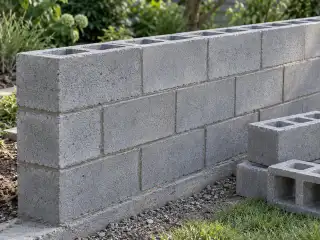
Concrete block calculator
For a nominal 16 × 8 in block face, multiply net wall area by 1.125 to estimate blocks before waste. Apply your chosen allowance and round the final order up. Subtract doors and windows first. Mortar depends on the yield of the exact product you will buy.
- Wall area
- 80 sq ft
- Blocks before waste
- 90
- Mortar bags
- Estimated material cost
How do I measure a wall for concrete blocks?
- Measure the planned wall length and height in the same units. Use the dimensions of the masonry itself; do not add a footing, cap or fence above it to the wall area.
- List every door, window and large vent. Multiply the width and height of each opening, add those areas and enter the total under openings. Do not subtract small hollow cores inside individual blocks.
- Choose the nominal block face, including its mortar-joint module. Width through the wall is a separate dimension: a thicker block with the same face covers the same wall area.
- Enter a waste allowance for your actual layout, then inspect the drawing, courses and purchase count. Confirm special units, lintels, corners and the supplier’s package quantities before ordering.
How is the quantity calculated?
Blocks to order = round up[(wall area − openings) ÷ nominal block face area × (1 + waste ÷ 100)]
- A 16 × 8 in nominal face covers 0.889 sq ft, including the joint module.
- Use feet for wall length and height, square feet for openings and the selected nominal block face.
- The waste percentage is an input. It is not a structural requirement or a guarantee that every cut can be reused.
Example: a 20 ft by 4 ft block wall
Illustrative takeoff only: no openings, a standard nominal face and a chosen 5% allowance. These dimensions do not specify a safe wall design.
- Length: 20 ft; height: 4 ft; openings: 0 sq ft.
- Nominal face: 16 × 8 in; chosen allowance: 5%.
- Net wall area is 80 sq ft.
- Before waste, the area requires 90 whole blocks.
- Adding the selected allowance and rounding up gives 95 blocks to order.
- The modular layout is 6 courses high and approximately 15 blocks per course before bond-pattern cuts.
- At the cited product’s yield of up to 13 standard blocks per 80 lb bag, this example estimates 8 mortar bags. Confirm product suitability and field yield.
95 blocks; 8 bags only for the specified mortar-yield assumption.
How many blocks do common wall sizes use?
| Wall size | Net area | Courses | No waste | Chosen 10% |
|---|---|---|---|---|
| 10 × 3 ft | 30 sq ft | 5 | 34 | 38 |
| 20 × 4 ft | 80 sq ft | 6 | 90 | 99 |
| 30 × 4 ft | 120 sq ft | 6 | 135 | 149 |
| 40 × 6 ft | 240 sq ft | 9 | 270 | 297 |
| 50 × 8 ft | 400 sq ft | 12 | 450 | 495 |
| 100 × 8 ft | 800 sq ft | 12 | 900 | 990 |
How many concrete blocks do I need per square foot?
For a nominal 16 × 8 in face, the area factor is 1.125 blocks per square foot before waste. Multiply that factor by the wall area after subtracting openings, then round the final order up to whole units. This is a calculation from the nominal dimensions, not a count of exposed concrete alone.
The shortcut changes when the face dimensions change. A half block or a half-high unit does not cover the same area as a full standard face. Select the face that matches the supplier’s specification. Do not enter actual unit dimensions and then add the joint a second time.
Should I use nominal or actual concrete block dimensions?
Use nominal modular dimensions for this calculator. CMHA explains that nominal dimensions include the mortar-joint module, while specified unit dimensions describe the block itself. Counting with the smaller physical face alone can overestimate how many units fit in a finished wall.
Check the drawings and product sheet if your project uses unusual joints, specialty shapes or metric modular units. Converting feet to meters does not turn an inch-based block into a different metric product. Keep the selected unit and its module consistent throughout the takeoff.
How do doors and windows change the block count?
Subtract their combined opening area from the gross wall area. A large opening removes masonry area, but it can also create extra cuts and require different units around its edges. The area deduction does not design lintels, jamb reinforcement or supports.
Openings must be measured as the masonry opening required by the project, rather than guessed from the visible glass or door leaf. If opening area is larger than the wall, the calculator returns no net blocks; that is a reason to check the inputs, not a valid wall layout.
Does a wider block change the number of blocks?
A wider unit with the same nominal face uses the same area count. Width can change handling, weight, cost, mortar bedding and any specified grout fill, but those quantities do not follow from wall area alone.
The courses result describes the vertical module. Blocks per course is an approximate layout aid; the purchase count is based on net area and your chosen allowance. Neither result is a cutting plan for corners, returns, running bond or openings. Review the layout with the actual unit shapes before buying.
How many bags of mortar do I need for a block wall?
Divide the blocks to order by the number of blocks that the selected mortar bag is stated to lay, then round up. Enter the yield from that product’s current label or data sheet. Bag weight by itself does not establish coverage, and mortar for masonry is a different product from concrete used to fill a footing.
The worked example uses the cited QUIKRETE Mortar Mix No. 1102 yield for standard blocks. Other products and bedding conditions can produce different bag counts. The calculator leaves mortar unresolved when no usable yield is entered. It does not estimate core grout or choose a mortar type for structural or exposure requirements.
How much extra block should I order?
Choose an allowance based on the bond pattern, cuts, breakage, supplier packaging and whether replacement units will be available. The example percentages here illustrate the arithmetic; they are not a universal recommendation for your wall.
Round-up handles whole units, while waste is a separate allowance. Avoid adding the same waste twice when a supplier quote already includes it. Ask whether special corner, end, bond-beam or cap units are included in the quoted count, and keep those items distinct from ordinary full-face blocks.
How do I estimate the material cost?
Use a current supplier price per block and, if known, per mortar bag. The result is the priced items you entered, before any unentered tax, delivery, equipment or labor. Save the quantities to your project list and compare quotes on the same scope.
Content updated . How we calculate. Source checks are listed below each reference.